Insect pests can significantly reduce tomato crop quality and yield. To protect their crops, growers often rely on repeated insecticide applications. However, this can increase production costs, create health and environmental risks, and contribute to pesticide resistance.
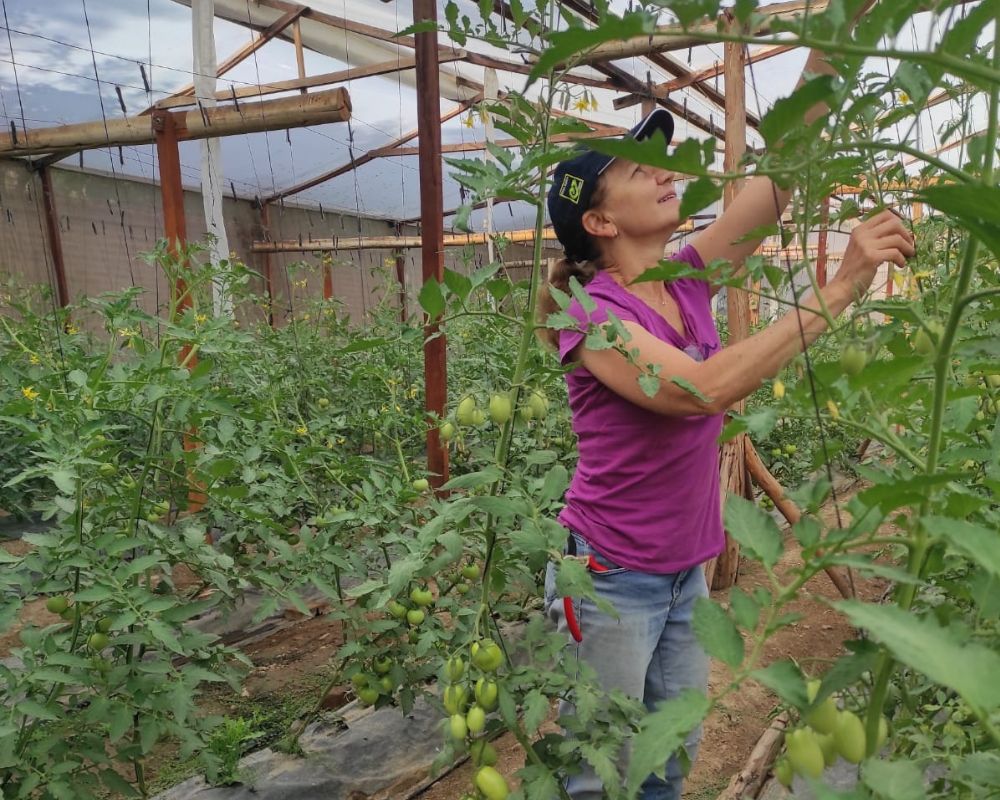
Claudia Sainz, a tomato grower in Cochabamba, Bolivia, wanted to find an alternative, more sustainable way to protect her crops. She used her background in agronomy and plant protection to explore how natural pest control can help manage pests more sustainably.
With support from PlantwisePlus training, CABI Academy courses and other PlantwisePlus digital resources, Claudia began putting her knowledge into practice. As a result, over a seven-month production cycle, her greenhouse remained free of severe pest outbreaks without conventional insecticides.
Looking towards natural pest control
Claudia wanted to adopt more sustainable pest management practices to lower production costs, improve crop quality and safety, and protect human health and the environment. Although she already had technical skills, she was keen to strengthen her practical skills.
She completed PlantwisePlus plant doctor training and four CABI Academy courses: Introduction to BioProtection Products, Crop Pest Diagnosis Fundamentals, Integrated Pest Management Fundamentals and Reducing Pesticide Risk. Drawing on this knowledge, Claudia began applying integrated pest management (IPM) principles in her greenhouse.
She also used PlantwisePlus digital resources such as the CABI BioProtection Portal and PlantwisePlus Knowledge Bank to access reliable technical information and support her pest management decisions throughout the growing season.
“Having access to reliable information whenever I needed it gave me the confidence to try new approaches,” she explains.
For Claudia, this meant moving beyond individual pest control measures and considering how different practices could work together to protect her crops.
The training and resources helped Claudia translate her existing knowledge into practical changes. She began combining biological control, biodiversity conservation, and regular pest monitoring to create a greenhouse environment that supports natural pest management.
Creating a greenhouse that supports natural pest control
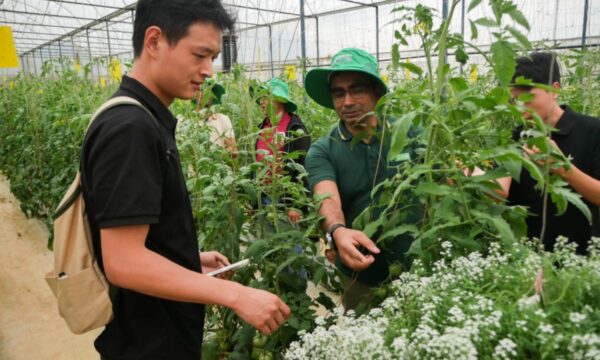
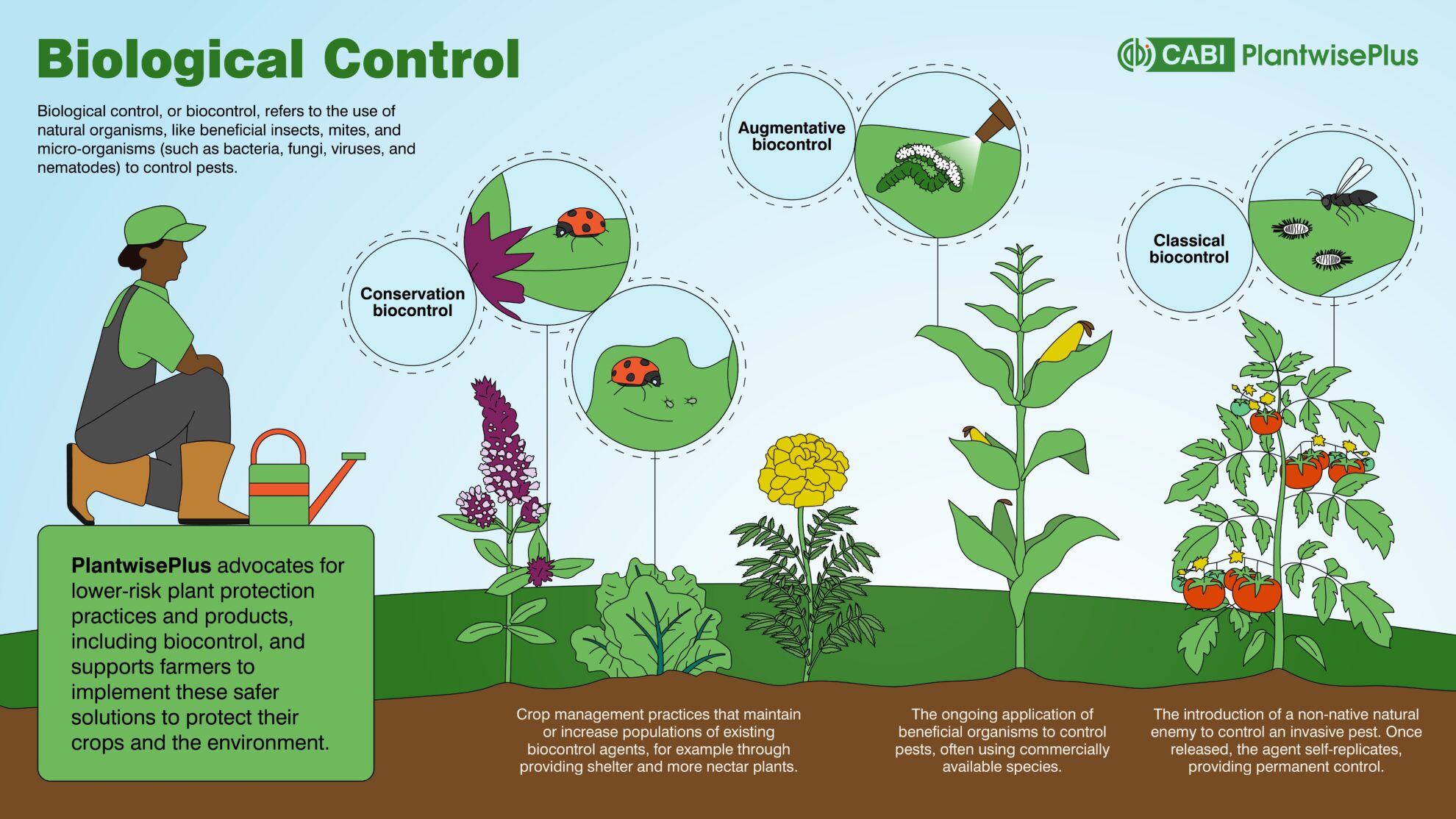
Claudia also redesigned her greenhouse to encourage beneficial insects. She planted flowers such as calendula, lavender, zinnia, snapdragon, and aromatic plants both inside and around the greenhouse. These provided pollen, nectar, and shelter for beneficial insects, including predators and parasitoids that help control crop pests.
This approach, known as habitat management, helps create the right conditions for natural enemies to establish themselves and help manage pest levels. This includes parasitoids, which develop in or on their insect hosts, eventually killing them and helping to regulate pest populations.
At the same time, Claudia implemented regular pest monitoring using yellow and blue sticky traps together with pheromone traps for the tomato leaf miner. Regular monitoring helped her track pest populations and decide when intervention was needed, rather than automatically applying insecticides.
Biological and botanical products developed and produced in Bolivia, including entomopathogenic fungi and other bioprotection products, were applied as part of an integrated strategy. These products complemented the beneficial insects already present in the greenhouse and helped manage pest populations.
“Instead of asking which insecticide to use, I now ask how I can create the right conditions for nature to help me manage the pests,” says Claudia.
Seeing the benefits of a different approach
Changing established farming practices can involve uncertainty. Rather than changing everything at once, Claudia gradually introduced and tested new approaches, building her knowledge and confidence along the way. Her careful preparation and persistence helped her achieve the results she sees today.
Monitoring revealed high levels of activity among the beneficial insects Claudia had encouraged. More than 85% parasitism of whitefly by Encarsia spp. was observed, while over 90% parasitism of aphids by Aphidius spp. was recorded on associated plants within the greenhouse. These observations show that naturally occurring parasitoids contributed to pest management.
Naturally occurring populations of the entomopathogenic fungus Isaria also helped suppress whitefly populations.
“One of the lessons I learned is that beneficial insects can become your best partners if you give them the right environment,” says Claudia. “Today I produce tomatoes in a way that is healthier for my family, for consumers and for the environment.”
Sharing what works with other growers
Claudia’s experience shows the value of continuous learning and access to reliable technical information.
Today, she not only produces tomatoes using IPM principles. She also welcomes growers and students to her greenhouse, where she delivers training and shares her experience of adopting more sustainable practices. In doing so, Claudia helps others explore how integrated pest management can support successful, sustainable crop production.
As more farmers and agricultural professionals gain access to these opportunities, they can become agents of change in their communities, helping to build more resilient and sustainable food systems across Bolivia.
Through PlantwisePlus, farmers not only learn about integrated pest management; they also gain the resources to put it into practice.
More information
Scaling sustainable food production using integrated pest management
Using biocontrol-based integrated pest management to reduce pollinator loss
PlantwisePlus
PlantwisePlus(opens in new tab)(opens in new tab)(opens in new tab)(opens in new tab) gratefully acknowledges the financial support of the Directorate-General for International Cooperation(opens in new tab)(opens in new tab)(opens in new tab)(opens in new tab), Netherlands (DGIS); European Commission Directorate General for International Partnerships(opens in new tab)(opens in new tab)(opens in new tab)(opens in new tab) (INTPA); UK International Development(opens in new tab)(opens in new tab)(opens in new tab)(opens in new tab) from the UK government; the Swiss Agency for Development and Cooperation(opens in new tab)(opens in new tab)(opens in new tab)(opens in new tab) (SDC); and the Australian Centre for International Agricultural Research(opens in new tab)(opens in new tab)(opens in new tab)(opens in new tab) (ACIAR).
Interested in learning more about PlantwisePlus?
PlantwisePlus works with partners including governments, research institutions, local NGOs, and regional plant protection organizations to strengthen plant health systems and improve food security.
>> Discover more about our approach and how we’re delivering sustainable impact.
Related News & Blogs
Ukulima True: Expanding pesticide risk reduction using a One Health approach
Ukulima True is a communications campaign that has helped to reduce pesticide risks among farmers in Kenya. Carried out under PlantwisePlus, it has reached a wide range of stakeholders, from smallholders and consumers to extension officers and policyma…
3 November 2026