Fall armyworm is a highly mobile crop pest that moves quickly between maize fields. Since it arrived in Africa, the pest has quickly spread across land managed by millions of smallholder farmers. The speed at which it moves makes its management complex. Rather than working independently, one field at a time, recent research from Zambia has shown the benefits of farmers taking collective action to control it.
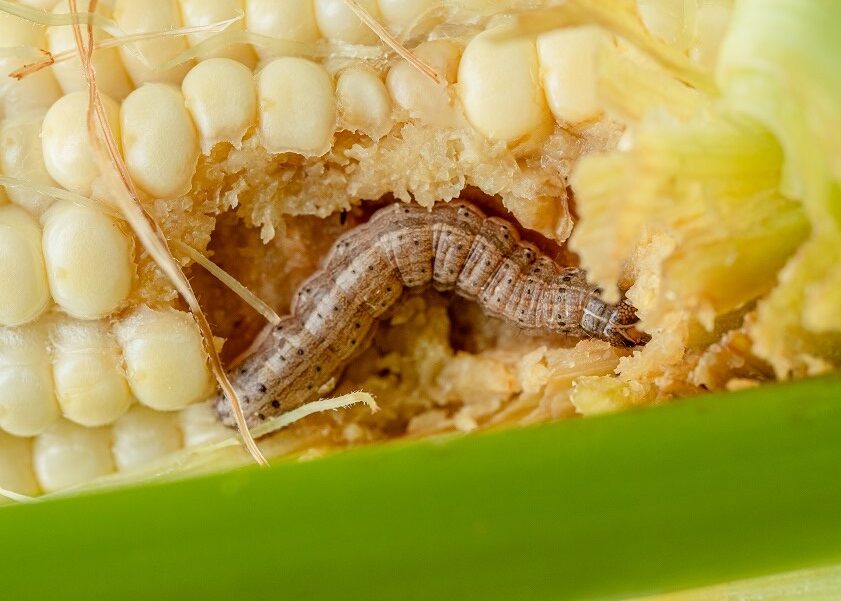
Conservation biocontrol such as intercropping can offer low-cost, simple solutions for smallholders. This is the process of growing two or more crop species at the same time in the same field. It boosts populations of naturally occurring beneficial enemies of fall armyworm, rather than introducing new ones. This nature-based solution offers smallholders an alternative to chemical pesticides.
New research carried out under PlantwisePlus shows that pest management is not only about giving farmers a product or recommendation. It is also about building the knowledge and systems that allow farmers to act collectively and effectively. In this blog, we look at findings, limitations, and ways to strengthen community-based efforts for fall armyworm management.
Putting collective pest management into practice
Between 2019 and 2022, researchers worked with communities in Zambia’s Mumbwa and Siavonga districts to understand how farmers can join efforts to reduce fall armyworm populations at village-level. Farmers in both communities were positive about taking collective action to tackle the pest. While pesticides are the ‘go-to’ solution for managing crop pests, indiscriminate use can lead to pest resistance. Moreover, they can harm populations of beneficial pest enemies, resulting in more outbreaks.
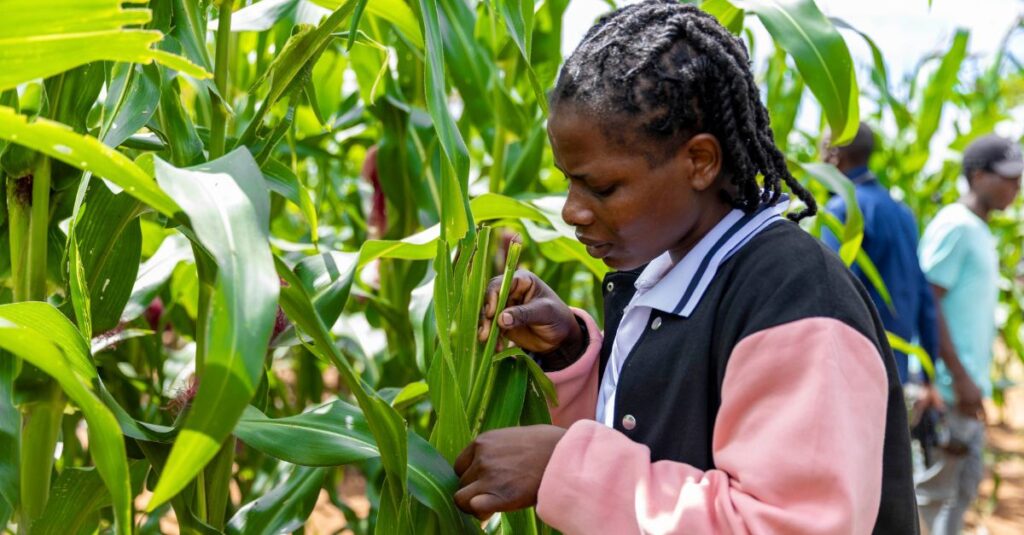
Through PlantwisePlus, farmers learned about nature-based solutions such as maize intercropping with local companion crops. They tested how well these companion crops strengthened the presence of fall armyworm’s natural enemies and, therefore, deterred the pest’s spread. Lead farmers hosted demonstration plots where they grew maize with cowpeas, groundnuts, and sunflowers. These plant species support natural pest enemy populations via extra-floral nectaries – the nectar-producing glands found on parts of the plant other than the flower, such as the leaves and stalks. The researchers collected data with the support of farmers on fall armyworm’s presence in the various plots and the abundance of the pests’ natural enemies. They shared their experiences with the different intercropping combinations.
At the end of the rainy season, scientists presented information on rates of fall armyworm suppressed by natural enemies compared to the abundance of surviving fall armyworm (intercrop vs maize monocrop). The meetings provided a space for farmers and scientists to share experiences and co-design next steps for managing the pest at a community level.

Farmers want to learn about and coordinate pest management
The study showed that communities had good local knowledge about pests, but also that the project improved their knowledge around concepts such as biocontrol, natural enemies, and intercropping. Farmers were better able to describe biocontrol, identify natural enemies, and explain how these natural enemies help prevent or slow the spread of fall armyworm. This matters because understanding how a pest management strategy works supports its effective implementation. Farmer knowledge is not a side issue; it is a core part of the solution.
The research also highlighted that individuals were highly willing to implement practices collectively, such as conservation biocontrol and intercropping, to manage the spread of fall armyworm. This insight could help to strengthen extension services and pest management advice. Support traditionally focuses on the individual or the farm level. However, more information about coordinating action among neighbouring farms could help smallholders work together to achieve better pest management results. This would be especially useful regarding highly mobile pests such as fall armyworm.
Practical barriers can hinder collective action
Collective pest management promises great potential for farming communities to tackle serious plant health threats. However, the study also revealed some limiting factors to collective management of, in this case, fall armyworm using intercropping. Coordinating action among farmers, as well as the knowledge from the extension officers that support them, can be lacking. Understanding of pest management planning was limited to purchasing chemical insecticides. Limited knowledge of other pest management approaches is a major barrier to long-term, sustainable strategies.
Other hurdles included a lack of knowledge about suitable crop combinations, optimal planting times, and general intercropping practices. Additionally, some farmers described how intercropping would not work with their current farming practices, such as ploughing with oxen. Other notable constraints included lack of access to financial resources and inputs such as seed for crops other than maize.
What this means for farmer advisory services
Collective pest management using biocontrol has great potential for smallholder farmers in low- and medium-income countries. However, the results show that no one-size-fits-all model exists for collective pest management. While farmers may have a good understanding of pest biology and ecology, a lack of awareness and support for coordinating efforts among farmers can hinder efficient and effective action. The research showed that the question is not simply “Do farmers know about biocontrol and intercropping?” It is “Do farmers have the coordination mechanisms, knowledge, and support needed to act together?”
Collaboration relies on farmer knowledge, established social capital (the relationships between farmers that already exist), the ability to coordinate, and, above all, adaptable systems that consider local contexts. Close collaboration with traditional leaders, such as influential elders, is critical for ensuring that communities self-organize and sustain collective action. National extension services will need to embed training for collective action, as well as pest management knowledge, into their systems.
To achieve this, more needs to be done to develop policies and strategies at national levels, including a shift in curricula for extensionists. Farming communities are willing to cooperate when it comes to pest management. Their efforts can be linked through multi-level coordination with regional pest management programmes and national agricultural policies.
The future of collective action on fall armyworm
Fall armyworm does not respect farm boundaries, so sustainable management cannot rely solely on individual action. This piece of research shows that farmers are willing to cooperate, but they need support with coordination and knowledge-sharing to make that willingness work.
The future of fall armyworm management is not simply about finding new solutions. It is about ensuring farmers have the information and systems to use them collectively. Pests can spread quickly, and when they do, communities must be empowered to mobilize quickly too. This study shows that change is possible and that it can be further nurtured and strengthened with targeted support.
Further reading
Agricultural service providers are transforming rural livelihoods – here’s how
Zambia strengthens pest preparedness with launch of national pest risk register
PlantwisePlus
PlantwisePlus(opens in new tab) gratefully acknowledges the financial support of the Directorate-General for International Cooperation(opens in new tab), Netherlands (DGIS); European Commission Directorate General for International Partnerships(opens in new tab) (INTPA); UK International Development(opens in new tab) from the UK government; the Swiss Agency for Development and Cooperation(opens in new tab) (SDC); and the Australian Centre for International Agricultural Research(opens in new tab) (ACIAR).
Interested in learning more about PlantwisePlus?
PlantwisePlus works with partners including governments, research institutions, local NGOs, and regional plant protection organizations to strengthen plant health systems and improve food security.
>> Discover more about our approach and how we’re delivering sustainable impact.
Related News & Blogs
How IPM is helping Vietnam’s tomato farmers manage invasive tomato leafminer
Tomato farmers in Lam Dong Province, Vietnam, are gaining practical knowledge on managing the invasive South American tomato leafminer. The pest, Phthorimaea absoluta (formerly Tuta absoluta), can be difficult to control once established. Through integ…
14 October 2026