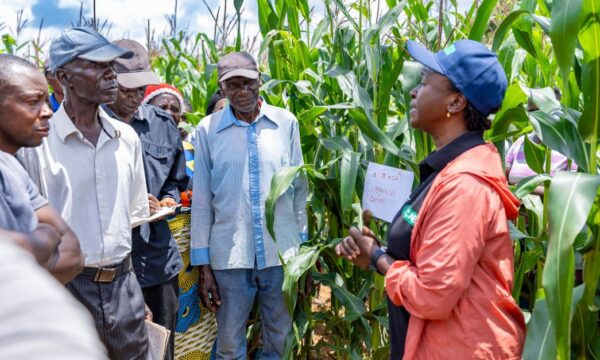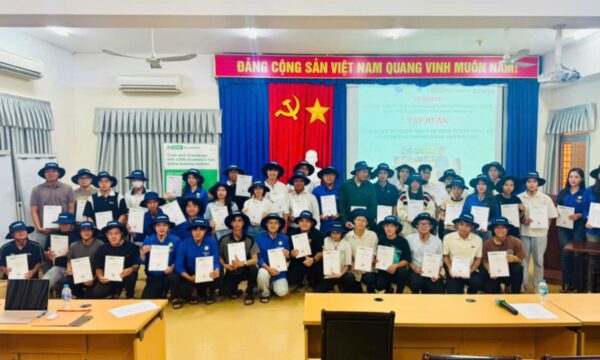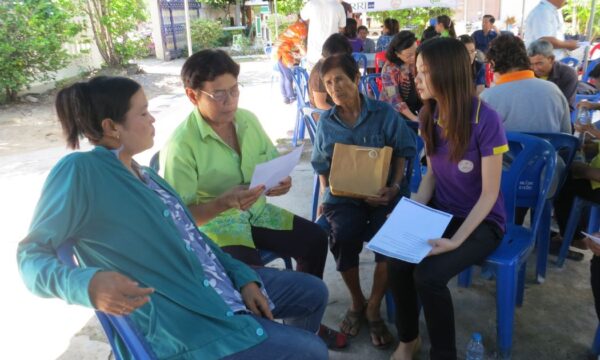
Gender Technical Working Groups are an effective way to bring together and support organizations that empower women farmers. In 2025, PlantwisePlus strengthened its work around gender responsiveness in agricultural advisory services. Focusing on Bangladesh, Ghana, Pakistan, and Zambia, the programme increased its stakeholder coordination and training with great results. In this blog, we look at the changes that one working group in particular has made for the lives of women farmers.

Why women farmers need dedicated support
Agricultural advisory services sometimes overlook women farmers. Extension support often targets heads of households, and this means women’s needs as farmers and farm labourers can go unmet. As a result of gender and social norms, they often lack access to agricultural knowledge and training. Additionally, they lack access to inputs such as land, seed, and fertilizers, and resources including finance and credit. Gender responsive support can help them to achieve that access.
Increasing women farmers’ productivity is not just good for the women and their families and communities; it makes sense in terms of global food security as well. If women had the same access to resources as men, farm yields would increase by 20-30%. In 2011, the FAO reported that this would reduce the number of people who go hungry in the world by around 100-150 million. In other words, empowering women farmers supports broader sustainability goals such as SDG 2: Zero Hunger.
Gender Technical Working Groups enhance women’s empowerment
In Ghana and Pakistan, the programme institutionalised existing Gender Technical Working Groups, bringing them into local government structures. PlantwisePlus also introduced the working group model to Zambia, and – based on the success of other groups – to Bangladesh as well, creating them in partnership with local organizations. These innovative forums have emerged as a concrete way of enhancing gender-responsiveness in advisory services.
Through close collaboration with government ministries, the Gender Technical Working Groups are increasingly turning dialogue into practical changes. They are increasing knowledge and skills in planning, coordination, and service delivery for:
- researchers
- policy actors
- extension staff
- media professionals
As the groups develop, governments are stepping in to take a lead and ensure their valuable work keeps delivering results. As this happens, the groups become a stronger part of existing government structures, meaning they become sustainable. Through them, agricultural systems continue to apply gender-sensitive approaches and promote gender equality, and women farmers receive the support they need.
Pakistan – results at many levels
In Pakistan, PlantwisePlus strengthened gender responsiveness across government extension systems. It did this by working through existing structures and driving change at three interconnected levels:
- the enabling environment
- institutional systems
- individual capacity
By working through existing government structures rather than creating new mechanisms, the programme integrated gender within mainstream agricultural policy and service delivery. We are now seeing progress and tangible results in co-ordination mechanisms, institutional reforms, and frontline practice.
At the enabling environment level
Here, the programme elevated ‘gender’ as a strategic priority within federal and provincial agriculture departments. It supported the integration of gender objectives into policy frameworks. In addition, it helped the Gender Technical Working Groups to evolve into a nationally owned co-ordination platform. Moreover, the commitment of national institutions to continue convening this forum supported growing ownership and sustainability.
At the institutional level
At this level, PlantwisePlus built the capacity of extension leaders and training institutions to deliver inclusive advisory services. Gender-responsive tools introduced through the working groups are now included in planning processes, curricula, and project design. Provinces have launched targeted services for women farmers. As a result, an estimated 75-80% of departmental plans now include gender components. Gender considerations are, therefore, increasingly embedded in routine extension planning and implementation. In this way, they are bringing about meaningful institutional change.
At the individual capacity level
Individuals are also seeing beneficial changes. Extension staff have strengthened their technical skills to deliver gender-responsive services. In addition, several institutions introduced measures to improve workplace conditions for women staff. This has helped to address barriers to recruitment, retention, and field participation.
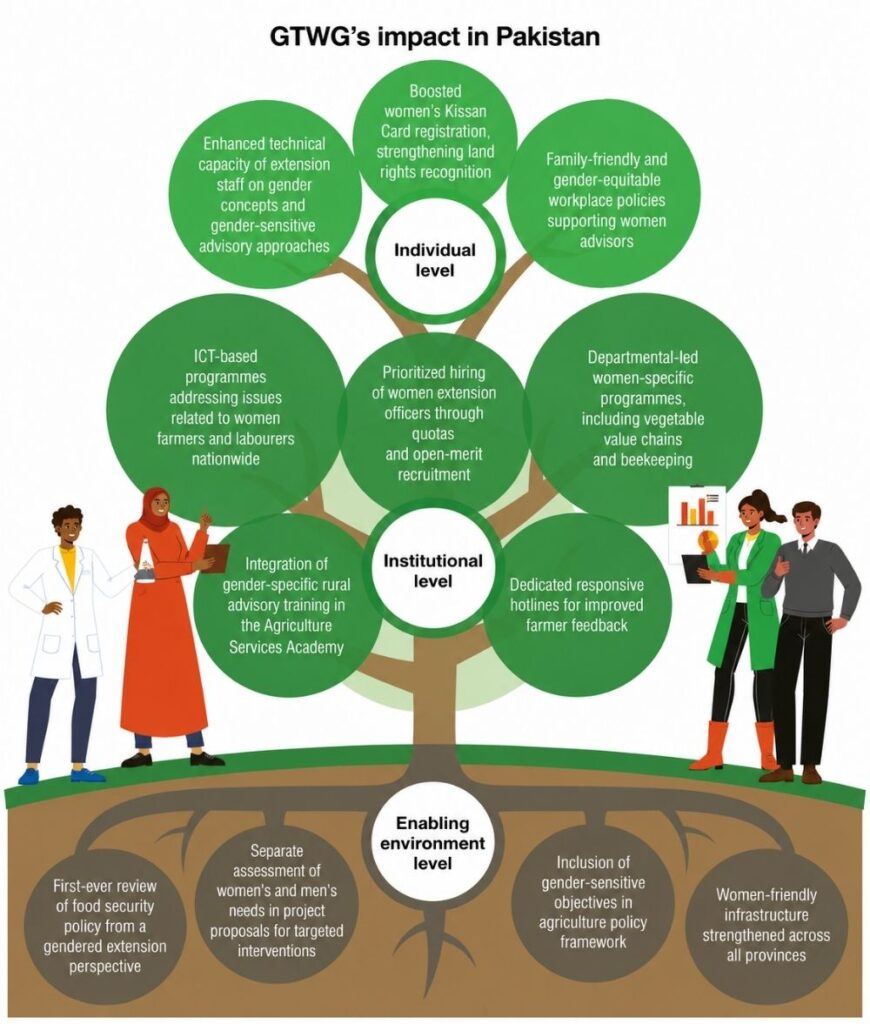
to gender mainstreaming in Pakistan
The bigger picture
In 2025, PlantwisePlus continued to integrate gender into frontline advisory services. Gender-responsive approaches were incorporated into plant doctor training and extension capacity strengthening activities. In addition, service delivery models were adapted to improve accessibility for both women and men farmers. As part of this effort, the programme addressed barriers to digital advisory access through targeted digital literacy initiatives.
The programme also strengthened women’s and youth’s roles in agricultural systems. It achieved this through partnerships with private sector and market institutions across Bangladesh, Kenya, Nepal, and Uganda:
- Bangladesh: Collaborations with financial institutions supported women entrepreneurs.
- Kenya: Work with county authorities and exporters helped women- and youth-led groups enter formal markets.
- Nepal: Partnerships with national agencies and NGOs revitalized community-based service models.
- Uganda: Coordination with seed and input regulators helped embed young service providers in recognized systems.
Together, these efforts expanded market pathways and positioned women and youth as credible private agri-service providers. Furthermore, across behaviour change and communication initiatives, the programme designed outreach strategies to broaden access. These included:
- community forums
- radio programming
- local-language delivery
- participatory training methods in areas where women’s access to extension services may be constrained
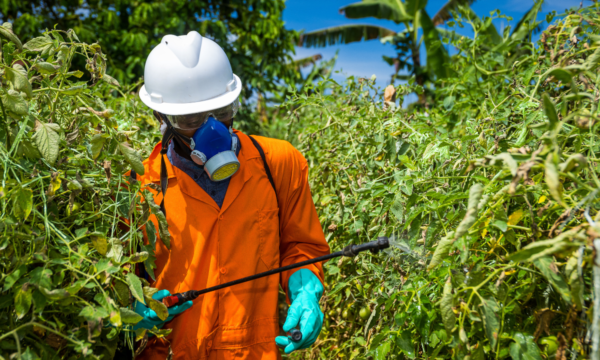
In particular, the programme applied gender-responsive approaches in pesticide risk reduction. This included integrated pest management (IPM) campaigns to support inclusive participation. Participatory methods were also used in technical field activities, including biological control initiatives. This meant that women farmers were involved directly in field demonstrations and community-level knowledge sharing.

Solving global food security
Gender Technical Working Groups are valuable forums for ensuring that the issues affecting women farmers are recognized and integrated into agricultural policy and practice. Through consistent gender mainstreaming, they help address women’s specific needs in agriculture while creating opportunities for women to add value across the food value chain. By enhancing women’s productivity and economic participation, these groups contribute to improved food and nutrition security not only in countries such as Pakistan, but also at the regional and global levels.
Read more:
PlantwisePlus Annual Review 2025
PlantwisePlus
PlantwisePlus gratefully acknowledges the financial support of the Directorate-General for International Cooperation, Netherlands (DGIS); European Commission Directorate General for International Partnerships (INTPA); UK International Development from the UK government; the Swiss Agency for Development and Cooperation (SDC); and the Australian Centre for International Agricultural Research (ACIAR).
Interested in learning more about PlantwisePlus?
PlantwisePlus works with partners including governments, research institutions, local NGOs, and regional plant protection organizations to strengthen plant health systems and improve food security.
>> Discover more about our approach and how we’re delivering sustainable impact.
Related News & Blogs
How IPM is helping Vietnam’s tomato farmers manage invasive tomato leafminer
Tomato farmers in Lam Dong Province, Vietnam, are gaining practical knowledge on managing the invasive South American tomato leafminer. The pest, Phthorimaea absoluta (formerly Tuta absoluta), can be difficult to control once established. Through integ…
14 October 2026