Black Rot Disease Hits Uganda

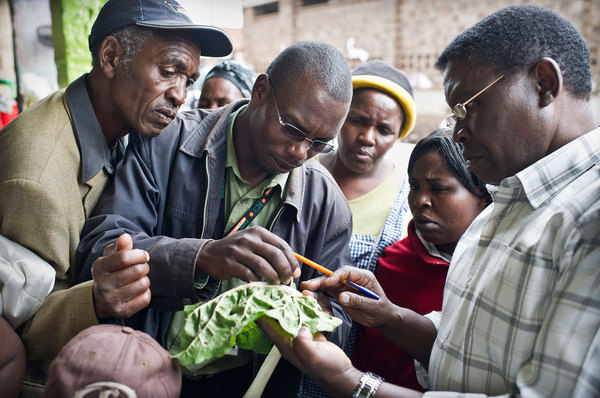
A photograph of a cabbage leaf showing symptoms of black rot. Image by USDA Forest Service via Wikimedia Commons (CC-BY 3.0)

A photograph of a cabbage leaf showing symptoms of black rot. Image by USDA Forest Service via Wikimedia Commons (CC-BY 3.0)

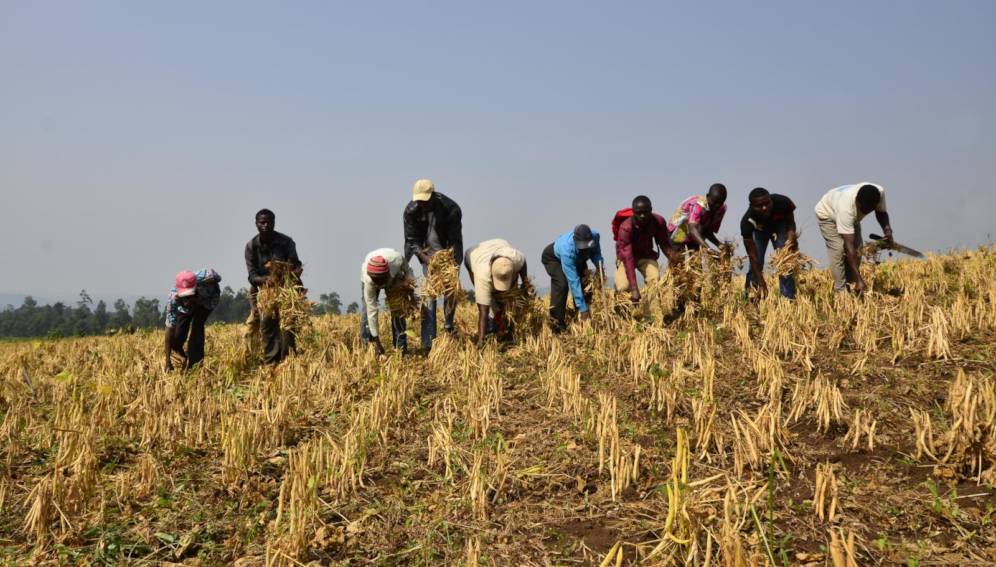
Vegetable farmers in the Kayunga and Mukono districts of Uganda are reporting crop losses due to black rot disease. One farmer, Twaha Kahooza of Kyampisi village, Kayunga Sub-county, says he had planted four acres of cabbages and was expecting about Shs18m (about £4,500 or US$7,000) from the harvest, however he only managed to get Shs5m (about £1,200 or US$2,000).

Black rot is caused by the bacterium Xanthomonas campestris pv. campestris and is one of the most destructive diseases of cabbage and other crucifers such as  broccoli, brussels sprouts, Chinese cabbage, collards, kohlrabi and mustard. The disease is usually most prevalent in low lying areas where plants remain wet for long periods. The disease is characterized by a yellow V-shaped lesion at the leaf margin which turns brown as the leaf area expands. The disease can also affect seedlings and can enter the plant through insect feeding or injury to the plant. Management of black rot in crucifers includes obtaining certified, pathogen free seed, ensuring there is enough space between plants and crop rotation.To read more about black rot and black rot management visit factsheets on the Plantwise Knowledge Bank.  

To read a Plantwise Factsheet for Farmers written in Uganda click here. 

To find out more about Plantwise plant clinics running in Uganda, click here

References:

‘Farmers count losses over black rot disease in cabbage’, Fred Muzaale, April 2013, Daily Monitor 

Plantwise Uganda to add thirty plant doctors to their pool

 Contributed by Jane Frances Asaba and Joseph Mulema, both CABI Africa, and Phil Taylor, CABI Egham-UKImage  Plantwise has been operating in Uganda for 8 years, throughout which progress in setting up plant clinics with partners has been slow but steady.  Recently, things are really taking off; extension workers being instructed to attend courses by their superiors, and their role as plant doctors is becoming part of their expected duties. Read more of this post

Organized and motivated, African plant health leaders take issue in Rome

Image

Participation in the Commission on Phytosanitary Measures (CPM) is much more than just turning up. It needs a good understanding of the technical issues involved, and of the way in which decisions are reached. To be heard, interventions from the floor must be made in the right way at the right time. So to build the consensus on which CPM depends, delegates from the same region with common interests often support each other in plenary. But to be effective, this approach needs planning.

Read more of this post

Maize Lethal Necrosis Disease Spreads To Uganda

Maize plants showing Maize Lethal Necrosis disease © CIMMYT via Flickr (License CC-BY-NC-SA 2.0)

Maize plants showing Maize Lethal Necrosis disease © CIMMYT via Flickr (License CC-BY-NC-SA 2.0)

Maize Lethal Necrosis disease, which was first reported in Kenya and Tanzania, has now spread to Uganda, raising concerns for food security in the country. The Ministry of Agriculture has warned that Maize Lethal Necrosis has been reported in districts in eastern Uganda, including Busia and Tororo.

A spokesman for the Agriculture Research Organisation, Robert Anguzo, has said that Ugandan scientists are working in collaboration with the International Maize and Wheat Improvement Centre (CIMMYT) to find management solutions to the disease.

More information about the pests and viruses associated with Maize Lethal Necrosis and the management of the disease can be found on the Plantwise Knowledge Bank

Read more of this post

How Mobile Technology is Transforming Livestock Farming In Kenya

A fish farmer in Nigeria using a mobile phone to communicate to buyers in the capital © Reboot via Flickr (CC-BY-NC 2.0)

A fish farmer in Nigeria using a mobile phone to communicate to buyers in the capital © Reboot via Flickr (CC-BY-NC 2.0)

Farmers and vets across Africa are increasingly using mobile phones to issue alerts about potential pest and disease outbreaks. The recent introduction of mobile phones that use the open source Android operating system or the iPhone iOS operating system and include GPS and Google Maps have provided new opportunities for developing mobile phone applications, allowing communication between field workers and their project databases. ‘Smartphones’ offer computer like functionality and internet connectivity with built in Global Positioning System (GPS) receivers that give a detailed location reference.

Mobile phone applications can be installed on the phone to issue early warnings of pest and disease outbreaks. In Kenya, where three out of four people are reported to have a mobile phone, the Food and Agriculture Organisation (FAO) has partnered with the Royal Veterinary College and local NGO VetAid to support pilot testing of a mobile phone application called EpiCollect, developed by a research team led by David Aanensen at Imperial College London. EpiCollect is a generic software developed for Android and iPhone which allows multiple data records to be entered and stored on a mobile phone and linked to a central web application that allows mapping, visualisation and analysis of data from a central database. The latitude, longitude and altitude of the current position of the user is returned from the GPS unit of the phone.

Read more of this post

Improving Food Security Using Agroforestry Schemes

Agroforestry is an integrated system of trees and shrubs and/or crops and livestock within a managed agriculture area and has potential in improving food security in developing countries by fully utilising land, improving crop yields, diversifying farmer income and improving environmental sustainability.

Last month the United National Food and Agriculture Organisation (FAO) published an “Advancing Agroforestry on the Policy Agenda” guide, detailing case studies from countries including Kenya, Costa Rica, Ghana, Nigeria and Cameroon.

To read more about agroforestry and how it can be beneficial in farming systems see this recent article “How agroforestry schemes can improve food security in developing countries” by Caspar van Vark in The Guardian newspaper. 

Faidherbia is an indigenous African acacia which has been found to be useful in agroforestry systems due to the fact it sheds its nitrogen rich leaves in during the early rainy season when crops are being planting, thereby fertilising crops. Studies have found that Faidherbia-maize intercropping can increase maize yields by up to 400% in one area in Malawi. This photo shows Borassus palm intercropped with Faidherbia in Burkina Faso © Marco Schmidt via Wikimedia Commons (CC-BY-SA 2.5)

Faidherbia is an indigenous African acacia which has been found to be useful in agroforestry systems due to the fact it sheds its nitrogen rich leaves during the early rainy season when crops are being planting, thereby fertilising crops at an important time. Studies have found that Faidherbia-maize intercropping increased maize yields by up to 400% in one area in Malawi. This photo shows Borassus palm inter-cropped with Faidherbia in Burkina Faso © Marco Schmidt via Wikimedia Commons (CC-BY-SA 2.5)

Monitoring and Management of Desert Locusts in Africa

An adult Desert Locust © AtelierMonpli via Wikimedia Commons (License CC-BY-SA-3.0)

An adult Desert Locust © AtelierMonpli via Wikimedia Commons (License CC-BY-SA-3.0)

The United Nations Food and Agriculture Organisation (FAO) has this month warned that Desert Locust (Schistocerca gregaria) swarms are invading cropping areas of northern Sudan. The swarms originated from winter breeding areas on the Red Sea coastal plains and subcoastal areas in northeast Sudan and southeast Egypt. The situation requires close monitoring as more swarms are expected to form in the coming weeks that could move into parts of  Sudan and southern Egypt. If no further rains fall and the vegetation dries out, some of these swarms could move into the interior of both countries and also cross the Red Sea to the coast of Saudi Arabia.

Locusts belong to the Acrididae family (in the order Orthoptera which includes grasshoppers and crickets) and when triggered by certain cues such as increased crowding with other locusts have the ability to change their morphology, behaviour and physiology over several generations. This phase change occurs from a solitary to a gregarious phase, eventually causing the locusts to form dense hopper bands and swarms. One of the most serious locust pests is the Desert Locust.

Read more of this post

How The Gates Foundation and Carlos Slim are Supporting Innovation and Crop Improvement For Farmers

Carlos Slim, Bill Gates and Mexican Dignitaries visit CIMMYT to inaugurate the new Bioscience facilities © Eruviel Avila (CC-BY-NC-SA 2.0)

Carlos Slim, Bill Gates and Mexican Dignitaries visit CIMMYT to inaugurate the new Bioscience facilities © Eruviel Avila (CC-BY-NC-SA 2.0)

The Bill & Melinda Gates Foundation and Fundación Carlos Slim have announced a partnership in support of efforts by the Centro Internacional de Mejoramiento de Maíz y Trigo (International Maize and Wheat Improvement Center CIMMYT) in Mexico to develop and disseminate higher-yielding, more resilient wheat and maize varieties. Read more of this post

New Type of Invasive Whitefly Recorded In South Africa

The whitefly Bemisia tabaci (USDA image PD USDA ARS via Wikimedia Commons)

The whitefly Bemisia tabaci (USDA image PD USDA ARS via Wikimedia Commons)

A species of whitefly that transmits cassava mosaic virus has been detected in South Africa for the first time. The whitefly, Bemisia tabaci is a cryptic species complex containing some important agricultural pests and virus vectors. The term ‘cryptic species complex’ means that Bemisia tabaci is considered to be a complex of at least 24 different species that look almost identical but are in fact genetically different.  Researchers from a range of organisations including the University of Johannesburg, the University of Witwatersrand and ARC-Vegetable and Ornamental Plant Institute conducted surveys to investigate the diversity and distribution of Bemisia tabaci species in 8 provinces in South Africa. The study aimed to update the information regarding the different Bemisia tabaci types present in the country.

Read more of this post

What CABI Is Doing To Tackle Major Coffee Rust Outbreaks In Central America

Guatemala has declared a state of agricultural emergency after coffee rust fungus has affected approximately 193,000ha of coffee, equating to 70% of the national crop. As a result of the outbreak, Guatemala is releasing $13.7m (£8.7m) in emergency aid to help farmers buy pesticides and to inform farmers on ways to manage the disease. Honduras and Costa Rica have already declared national emergency and El Salvador and Panama are also affected.

Coffee is a major export crop in many Central American countries and it is thought that this disease outbreak, which has been called “the worst seen in Central America and Mexico” by John Vandermeer, ecologist at the University of Michigan, will lead to big job losses. The Institute of Coffee in Costa Rica has estimated that the latest coffee rust outbreak may reduce the 2013-2014 harvest by 50% or more in the worst affected areas.

To find out more information about coffee rust view our Plantwise Knowledge Bank- Coffee Leaf Rust PDF booklet.

Symptoms of Coffee Rust (Hemileia vastatrix) © Carlos Roberto Carvalho, Ronaldo C. Fernandes, Guilherme Mendes Almeida Carvalho, Robert W. Barreto, Harry C. Evans (2011): Cryptosexuality and the Genetic Diversity Paradox in Coffee Rust, Hemileia vastatrix. PLoS ONE 6(11): e26387. {{doi:10.1371/journal.pone.0026387}} (CC-BY 2.5)

Symptoms of Coffee Rust (Hemileia vastatrix) © Carlos Roberto Carvalho, Ronaldo C. Fernandes, Guilherme Mendes Almeida Carvalho, Robert W. Barreto, Harry C. Evans (2011): Cryptosexuality and the Genetic Diversity Paradox in Coffee Rust, Hemileia vastatrix. PLoS ONE 6(11): e26387. {{doi:10.1371/journal.pone.0026387}} (CC-BY 2.5)

Read more of this post

Follow

Get every new post delivered to your Inbox.

Join 500 other followers

%d bloggers like this: