
Clustering to make a difference
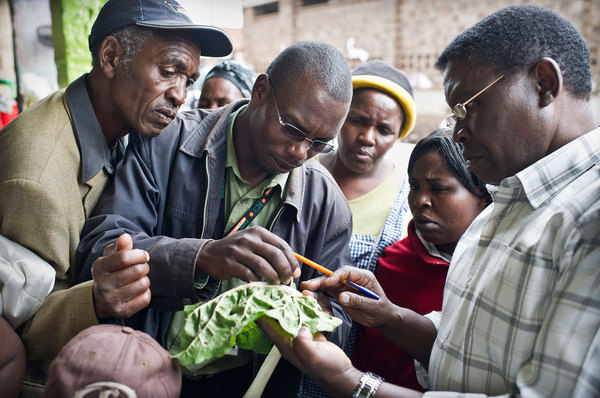
Claire Beverley from the Plantwise knowledge bank has been visiting Kenya, find out what she has been up to in her latest blog post! ———————————————————————————————————————————————————- I imagine there are few sights as breath-taking as the Rift Valley, so on Thursday I was pleased that we stopped for a few minutes on our way to Nakuru.…
Leaf miner becomes vine connoisseur
Leaf miners have an eclectic palate between them, enjoying everything from sweet potatoes to coconuts and cashews. It appears that at some point they decided that something was missing – perhaps a fine wine to wash it all down? After intensive studying of diet, morphology and DNA barcoding, it has been revealed that a mystery moth…
Shouting out about plant clinics
Plantwise works with in-country agencies to set up plant clinics, which farmers can attend with a sample of their affected crops to obtain a diagnosis and treatment advice. Plant clinics are often run in larger towns or villages, and farmers can travel many miles to talk to a plant doctor to solve their crop problems.…
Update: New Pest & Disease Records (21 Feb 12)
We’ve selected a few of the latest new geographic, host and species records for plant pests and diseases from CAB Abstracts. Records this fortnight include a new, unnamed virus infecting tomatoes and Euphorbia species in Venezuela; first reports of watermelon viruses in Palestine and Serbia; and a phytoplasma that infects prickly pear being found in…
Update: Plant Health News (16 Feb 12)
Here’s a taste of some of the latest plant health news stories, including plants that resist pests by telling the time, the fly that’s endangering German fruit crops, and why less snow has led to more yellow-cedar trees freezing this year. Click on the link to read more of the latest plant health news!
Need to control rodents on your crops? Use birds of prey!
The Society for the Protection of Nature in Israel is encouraging farmers to use barn owls (Tyto alba) to control rodent pests on their crops. They aim to attract barn owls by constructing nest boxes; so far 2,000 have been distributed to farmers. As barn owls only hunt at night, day-hunting kestrels are also being…
Plantwise relationships blossom in time for Valentine’s Day
With glossy pink shop window dressings and glittery red hearts everywhere, the arrival of Valentine’s day has been hard to ignore. Even Plantwise has not been able to escape it, with new relationships being established across the Atlantic last week. During a visit to Washington DC a new collaboration was agreed between Plantwise and the US…
Update: New Pest & Disease Records (09 Feb 12)
We’ve selected a few of the latest new geographic, host and species records for plant pests and diseases from CAB Abstracts. Records this fortnight include a new phytoplasma infecting soybean in Costa Rica, a parasitic nematode causing damage to several plant species in Brazil, and the Mediterranean fruit fly spreading and widening its host preference…
Amino acid stops citrus industry going sour
Lime Swallowtail by Tarique Sani, SANIsoft, Bugwood.org The citrus industry is of significant economic importance to the US, so when any potential pest appears on the horizon there is cause for concern. When the lime swallowtail (Papilio demoleus) was found in the Caribbean in 2006, scientists realised that it may only be a matter of time before these strong fliers appear…
Radio initiatives aiding remote African farmers
Information and communication technology has advanced rapidly in the past few decades. Many of us now take connection to the internet and easy access to information for granted. However, in remote parts of the world, even access to electricity is infrequent and unreliable, and communication technology is developing in a way that reflects this. In…