
Effective pesticide regulation is essential for protecting human health, safeguarding the environment, and supporting sustainable agricultural production. Robust pesticide dossier evaluation helps regulators determine whether products can be used safely under local conditions and ensures decisions are based on sound science and transparent processes.
These issues were the focus of the recent PlantwisePlus webinar, “Procedures for pesticide dossier evaluation: Lessons and best practices”. The event brought together regulators and scientific experts from Europe, Africa, and Asia to share experiences and insights. Participants explored how countries assess pesticide registration dossiers and use sound science, transparency, and effective governance to inform regulatory decisions.
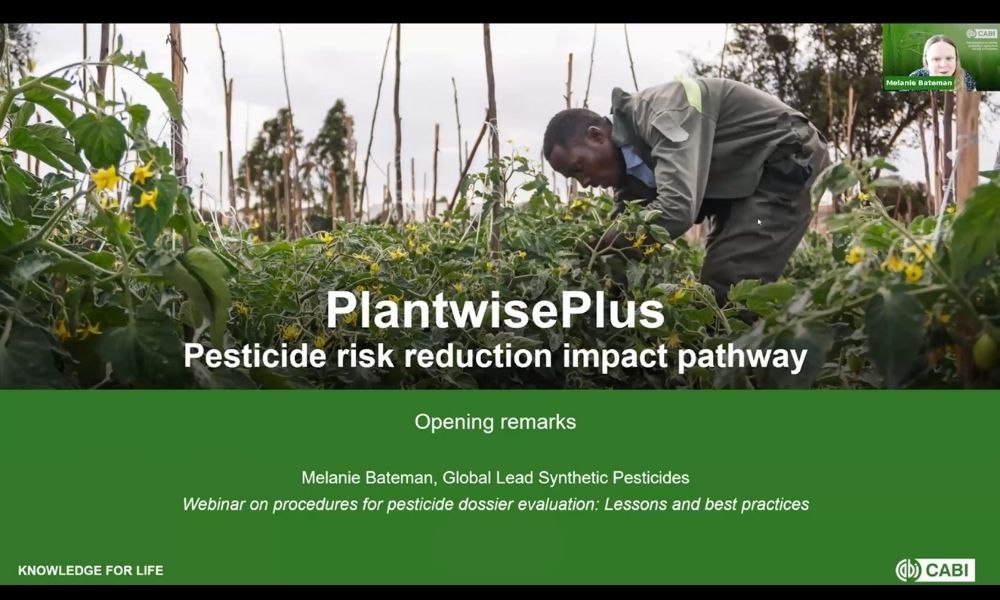
Naphis Bitange, Systems Scientist at CABI (Kenya), moderated the webinar, while Melanie Bateman, Global Lead – Synthetic Pesticides at CABI (Switzerland), opened the session.
The programme featured a distinguished panel of speakers, including Ulrike Frank from the Swedish Chemicals Agency (KEMI), Barasa Wanyonyi from the Pest Control Products Board of Kenya, Dr. Yue Geng from China’s Agro-Environmental Protection Institute (Ministry of Agriculture and Rural Affairs), and Dr. Wells Utembe from the National Institute for Occupational Health in South Africa. Together, these experts explored one central question: how can pesticide regulators strengthen dossier evaluation processes to better protect human health, the environment, and agricultural productivity?
Participants from Benin, Burundi, China, Ethiopia, India, Kenya, Sri Lanka, Sweden, South Africa, Uganda, Zambia and Zimbabwe joined the virtual meeting to identify critical components of pesticide assessment, share practical experiences across regulatory systems, and highlight priorities for improving consistency and capacity. The discussions made clear that while regulatory contexts differ, the need for scientifically rigorous and transparent processes is universal.
“The Pesticide dossier review sits at the heart of pesticide regulation, demanding rigorous scientific assessment of risks to human health and the environment. Yet even in such a well-established field, continuous improvement is essential. Exchanging lessons learned and sharing best practices across countries and regions supports this continuous improvement, elevating the consistency and quality of decision-making.”
Melanie Bateman, Global Lead – Synthetic Pesticides, CABI
A shared purpose: strengthening science-based regulation
PlantwisePlus delivered the webinar as part of its work under the Pesticide Risk Reduction pathway. As one of the programme’s three impact pathways, it supports governments, regulators and other stakeholders to strengthen pesticide governance, reduce pesticide-related risks and promote safer, more sustainable crop protection practices. A key part of this work is strengthening pesticide dossier evaluation to ensure regulatory decisions are grounded in sound science and effective governance.
PlantwisePlus supports this work at multiple levels, from strengthening national regulatory systems to helping farmers adopt integrated pest management (IPM) approaches and lower-risk crop protection solutions. In 2025, the programme supported Bangladesh, Kenya and Uganda in developing pesticide re-evaluation guidelines, helping regulatory authorities strengthen evidence-based review processes for registered products.
In Kenya, this support contributed to the development of pesticide re-evaluation guidelines that the Pest Control Products Board (PCPB) has now approved. The guidelines will support the periodic review of registered pesticide products and help ensure regulatory decisions continue to reflect the latest scientific evidence. During the webinar, PCPB also highlighted the importance of practical guidance for evaluators, particularly as new staff join regulatory authorities and take on increasingly complex dossier assessments.

Sharing lessons for pesticide dossier evaluation from global approaches
A major theme throughout the webinar was the integration of hazard and risk assessment in decision-making. Presenters illustrated how different regions apply this principle in practice.
The European approach, as described by Ulrike Frank, combines hazard-based exclusion criteria for substances with particularly concerning properties, such as carcinogenicity, with detailed exposure assessments to determine whether products can be used safely. Systems in Kenya and China, on the other hand, demonstrate how similar principles are adapted to national contexts, with increasing emphasis on tiered risk assessment frameworks, structured methodologies, and improved modelling tools.
China’s regulatory evolution stood out as a particularly striking example of rapid progress, moving toward a comprehensive, risk-based system with clearly defined protection goals. Meanwhile, Kenya provided a practical illustration of an end-to-end dossier evaluation process, spanning pre-submission consultations, completeness checks, expert technical review, efficacy trials, and final regulatory decisions. This structured, multi-layered approach highlights the importance of both scientific depth and institutional oversight.
Bridging gaps through collaboration
Beyond technical approaches, the webinar underscored the importance of capacity building and international collaboration. Many countries, particularly in Africa, continue to face challenges, including limited access to GLP-compliant laboratories, toxicology expertise, and locally relevant exposure data.
One webinar participant highlighted the importance of strengthening local capacity for pesticide exposure assessment, noting that “Africa needs to invest more in modelling pesticide exposure because this is really affecting the health of farmers.”
Speakers emphasized that while international tools and models, such as those developed by FAO, offer valuable support, they must be adapted to local realities. Without local validation, reliance on external data may lead to inaccurate conclusions about risk. At the same time, initiatives like PlantwisePlus play a crucial role in strengthening capacity through training, shared resources, and knowledge exchange platforms.
Key takeaways for the future
Several important messages emerged from the discussion. First, risk assessment must be context-specific. Even when hazard data is globally applicable, exposure, and therefore risk, varies significantly depending on local environmental, agricultural, and socio-economic conditions.
Second, scientific rigor must go hand in hand with legal clarity. Transparent, consistent processes supported by strong legal frameworks are essential for building trust and ensuring decisions stand up to scrutiny.
Third, while progress is evident, data gaps and capacity constraints remain significant barriers. Addressing these will require sustained investment in technical expertise, infrastructure, and locally generated data, including residue trials and exposure studies.
Finally, the webinar highlighted the need for stronger integration of environmental monitoring data into risk assessment and decision-making, as well as the importance of post-registration oversight, including monitoring, review, and re-evaluation of approved products.
Moving Forward
The webinar closed with a clear message: we cannot achieve effective pesticide regulation science alone. It requires a careful balance of global standards and local relevance, supported by strong institutions and continuous learning.
As countries continue to strengthen pesticide registration and review processes, effective pesticide dossier evaluation will remain central to protecting people, the environment and agricultural productivity.
By sharing lessons and best practices across regions, the PlantwisePlus community is helping regulators build more robust, consistent, and transparent systems. Ultimately, these efforts contribute to a common goal—reducing pesticide risks while supporting sustainable agricultural production and protecting both people and the environment.
Watch the full webinar: Procedures for Pesticide Dossier Evaluation: Lessons and Best Practices | PlantwisePlus Webinar
Further reading
Post-registration pesticide reviews: Experiences, learnings and best practices
A step forward for pesticide risk reduction in Sri Lanka with launch of new national committee
Reducing pesticide risks through public–private collaboration and long-term capacity building
PlantwisePlus
PlantwisePlus gratefully acknowledges the financial support of the Directorate-General for International Cooperation, Netherlands (DGIS); European Commission Directorate General for International Partnerships (INTPA); UK International Development from the UK government; and the Swiss Agency for Development and Cooperation (SDC).
Interested in learning more?
PlantwisePlus works with partners including governments, research institutions, local NGOs, and regional plant protection organizations to strengthen plant health systems and improve food security.
>> Discover more about our approach and how you can get involved.
1 Comment
Leave a Reply
Related News & Blogs
How IPM is helping Vietnam’s tomato farmers manage invasive tomato leafminer
Tomato farmers in Lam Dong Province, Vietnam, are gaining practical knowledge on managing the invasive South American tomato leafminer. The pest, Phthorimaea absoluta (formerly Tuta absoluta), can be difficult to control once established. Through integ…
14 October 2026
Very interesting wabinier and core issue are discussed regarding pesticides dossier evaluatikn