
Open source seeds
“Open source software is accompanied by a licence that encourages people to share it and create new programs with it, and at the same time prevents anyone from releasing a program that uses the code under any other form of licence. The creativity embedded in the code cannot be privatised. Kloppenburg and a group of…
Herbicide Resistance Gene In Black-Grass and Rye-Grass Identified
BBSRC (Biotechnology and Biological Sciences Research Council) and Syngenta funded scientists at the University of York and University of Durham have discovered a gene called AmGSTF1 that plays a key role in controlling multiple herbicide resistance in black-grass (Alopecurus myosuroides) and annual rye-grass (Lolium rigidum). Now the gene that confers resistance has been identified, it…
How plant clinics are helping farmers in Puducherry, India
Plantwise plant clinics are currently operating in 31 countries in Asia, Africa and Central & Latin America. Thousands of farmers come to these clinics for advice on managing their crops, particularly crops that are being affected by pests or disease. The video below gives the story of a farmer in Puducherry, India, who got advice…
New Mapping Tool Tracks Insecticide Resistance In Malaria Carrying Mosquitoes
Progress in malaria control in the past decade can be attributed largely to a massive increase in the number of insecticide based management programmes targeting malaria carrying mosquitoes, using methods that include indoor residual spraying and insecticide impregnated bed nets. The effectiveness of these management techniques is now being compromised by insecticide resistant mosquito populations. In…
Plantwise Photo Of The Month – July
This photo shows the Plantwise Knowledge Bank booth at the CABI Review Conference 2013, which took place from the 27-28th June in Oxford, UK. 70 delegates from 36 countries attended the review conference, in which research priorities aimed at protecting global food supply were discussed. To find out more about the review conference you can…
The Evolution of Insect Resistance to Bt Crops
A group of scientists at the University of Arizona have this week published a paper in Nature Biotechnology on the evolution of resistance in insect pests populations to insecticidal proteins from Bacillus thuringiensis (Bt) that are produced by transgenic crops. Resistance is defined as the phenotype of an individual that gives the individual the ability to…
Plantwise Photo Of The Month – June
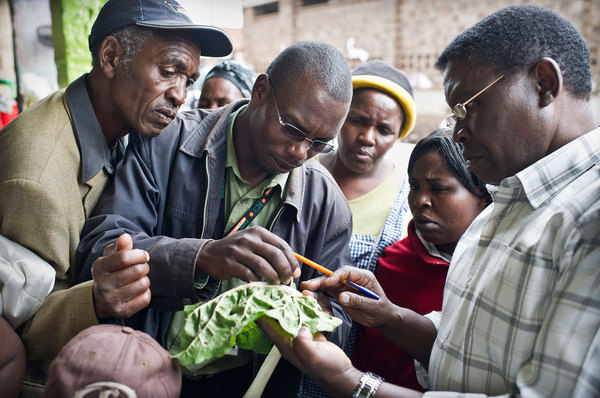
Photo Of The Month for June shows a plant clinic during market day at a village near Machakos, 50 kilometers outside Kenya’s capital city Nairobi. The photo shows a farmer showing a crop sample to a plant doctor, who is using his knowledge and reference material on the table to diagnose what is wrong with…
Glucose Leaves A Bitter Taste As Cockroaches Learn to Avoid Insecticide Baits
Populations of the German cockroach (Blattella germanica) have rapidly evolved to be repelled by the glucose in insecticide baits that are used to kill them. Scientists found that the cockroaches had a ‘re-organised’ sense of taste which makes them perceive the glucose in the insecticide bait as bitter and repellent rather than sweet. Researchers first…
Plantwise news update May 2013
The latest Plantwise newsletter is here. Click ‘Read more’ to find out about the launch of Plantwise in Ghana, discussions on greater collaboration between CABI and agricultural stakeholders in Myanmar, support for Plantwise from the European Union, and developments in the Knowledge Bank.
So how can we deal with all this plant clinic data?
There are many ways that data from plant clinics can inform agricultural activities. Clinic data can be used to identify the distribution of major crops and diseases, and help to flag up new and emerging pests and diseases. These data can also contribute to the monitoring of the quality of advice given to farmers at…