
Resolving pest problems in Trinidad and Tobago
Article by Shamela Rambadan, CABI Country Coordinator. In Trinidad and Tobago many Plantwise plant clinics have been implemented to provide free information and advice to smallholder farmers. To date there are 8 plant clinics in Trinidad and 2 are planned for Tobago. CABI Plantwise is partnered with the Ministry of Food Production with extension workers from the Ministry and…
Plantwise visits ‘open source GIS’ conference, FOSS4G 2013
On Thursday 19th November, I attended the ‘Free and Open Source Software For GIS’ (FOSS4G) conference in Nottingham, UK with two of my colleagues from the Plantwise Knowledge Bank. The conference, organised by OSGeo, had the strapline “Geo For All” and aimed to show that the tools that this Geographic Information Systems (GIS) community is…
Days are numbered for pests in Kenya’s irrigation schemes
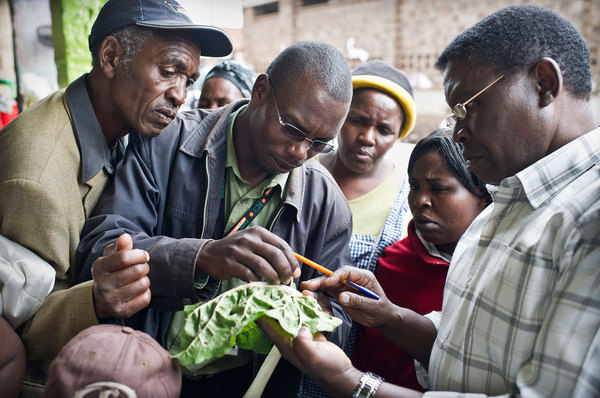
Report by Peter Karanja and Abigail Rumsey Between May and July this year, 22 new plant clinics were established in Kenya. Nine of these clinics were launched by the Smallscale Horticulture Development Project (SHDP), which has been funded by the African Development Bank to help smallholder farmers increase the amount that they produce and earn…
Warming Climate Marches Pests and Pathogens Polewards
The distribution of plant pests and pathogens has been observed to be moving away from the equator towards the North and South poles and inhabit areas previously too cold for their existence. This threatens to increase the percentage of crops lost annually to pests and pathogens and subsequently raises major concerns over global food security. A…
Plantwise Photo Of The Month- September
This photo was taken in July when data management training and Module 4 training took part in Sri Lanka. Twenty-seven participants took part in the Module 4 training, in which methods for managing and monitoring clinic data collected at plant clinics in Sri Lanka were discussed.
Update: New Pest & Disease Records (21 Aug 13)
We’ve selected a few of the latest new geographic, host and species records for plant pests and diseases from CAB Abstracts. Records this fortnight include a new species of rust fungus from India, the occurrence of Sclerotium rolfsii causing collar rot to Peperomia glabella in Argentina and the first report of the giant stem nematode Ditylenchus gigas from broad bean in…
Black Sigatoka Ravages Caribbean
Caribbean banana farmers are abandoning fields where crops have been badly affected by Black Sigatoka disease. Black Sigatoka has badly affected several countries in the region, including Dominica, St. Lucia, Grenada and Guyana. Black Sigatoka is considered the most destructive disease of bananas and plantains and is caused by the fungus Mycosphaerella fijiensis. It first arrived in…
Open source seeds
“Open source software is accompanied by a licence that encourages people to share it and create new programs with it, and at the same time prevents anyone from releasing a program that uses the code under any other form of licence. The creativity embedded in the code cannot be privatised. Kloppenburg and a group of…
Herbicide Resistance Gene In Black-Grass and Rye-Grass Identified
BBSRC (Biotechnology and Biological Sciences Research Council) and Syngenta funded scientists at the University of York and University of Durham have discovered a gene called AmGSTF1 that plays a key role in controlling multiple herbicide resistance in black-grass (Alopecurus myosuroides) and annual rye-grass (Lolium rigidum). Now the gene that confers resistance has been identified, it…