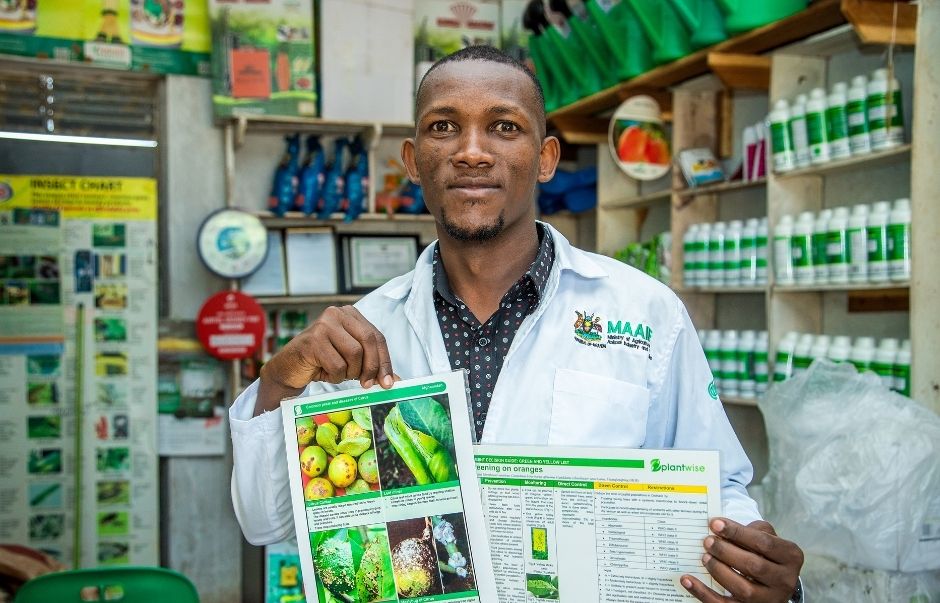
PlantwisePlus is changing lives. Today, Anthony Ssenyonga, 29, is an agro-input dealer, plant doctor, and entrepreneur in Uganda, but his story began very differently. Before his rise to digital agricultural champion, Anthony was a small-scale vegetable farmer, helping local households and schools to grow produce more cost-effectively. PlantwisePlus has played a transformative role in his journey. Once he trained as a plant doctor, he says his “life started changing.”
Equipped with new skills in crop health diagnosis and management, as well as agribusiness, Anthony reimagined his business and purpose. With PlantwisePlus training, he has successfully created a digital advisory hub on WhatsApp, which now serves over 500 farmers in Uganda’s Luwero District and beyond. He’s become a community champion of farmer-led innovation. This is the strength of a global plant health programme that empowers people with sustainable, science-based solutions.
Interconnected pressures are pushing farmers into crisis
For millions of smallholders around the world, poor plant health disrupts more than harvests alone. When pests destroy crops, food can quickly disappear, and incomes plummet. Farmers can no longer afford education for their children or healthcare. Moreover, they have less income to buy the food they cannot grow. On a broader scale, poor plant health destabilizes food systems. It leads to shortages, higher prices, and increased vulnerability for whole communities, sometimes whole regions.
Take, for example, invasive mealybug in Kenya. In places, it has reduced papaya farmers’ yields and incomes, on average, by 57%. However, it can destroy up to 100% of crops. Due to the severity of losses, some papaya farmers abandon cultivating the fruit altogether. A pest crisis like this makes timely agricultural advice critical for smallholders. Yet many struggle to access much-needed agricultural information. This is especially true for women farmers who face gender barriers.
Through PlantwisePlus, smallholders are not only able to access plant clinics and receive trained plant doctor advice. The programme also delivers long-term pest preparedness, preventing pest outbreaks that damage economies, and reduces harmful pesticide use, helping farmers to pivot from chemical products to lower-risk alternatives, which are safer for humans, animals and the environment.
A catalyst for personal and community transformation
This trifecta of pathways – farmer advisory, pest preparedness and pesticide risk reduction – creates a synergistic foundation for sustainable plant health. It takes solutions beyond crop health alone. When combined, the pathways help to increase food security, support farmers with climate adaptation, protect biodiversity, empower women and youth, and deliver science-based solutions that rural communities can embrace.
Climate solutions that help young people thrive
At just 24, Mary Mueni from Kenya wears many hats: Trainer of Trainers, agripreneur, and poultry farmer. The programme has given her a clear path forward. She explains, “I started as a jobless graduate. Now I’m a confident trainer and mentor, helping others to build a future in agriculture.” Moreover, PlantwisePlus has given her the tools to train 16 youth mentees in poultry management and feed cultivation. In addition, many of these young people have been inspired to create their own agri-enterprises.
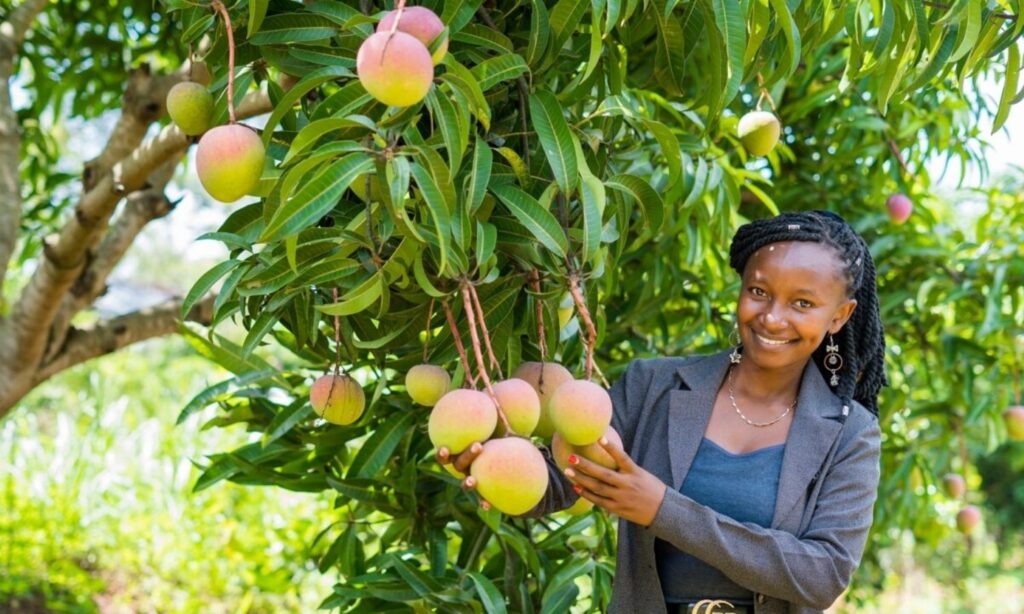
Shahadul Islam has also seen remarkable results in his farming business in Bangladesh. He is now a local role model for sustainable rice production, having adopted the PlantwisePlus digital tools and transformed his farming practices. Shahadul’s cultivation costs have decreased by around 5-6%, reducing unnecessary chemical use. At the same time, his rice yields have increased by 10-15%. More of his harvest now meets premium market standards than ever before.
Breaking down the gender barriers to knowledge
Breaking down the barriers that prevent women from accessing agricultural advisory services is critical. It’s not just a gender issue; it’s an investment in food security and economic development. When women grow stronger crops, they also grow stronger communities. A PlantwisePlus study showed how women in Uganda are benefitting from access to plant health knowledge. One farmer reported:
“I get increased yields on maize when there is enough rainfall. I also harvested a lot of bananas in the first season by following the advice of plant doctors.”
Moreover, when women access knowledge, they increase their influence in their households and communities. In Ghana, a radio campaign reached over half a million men and women in rural communities, helping them to change their beliefs around gender and women’s roles in farming. With new perspectives, men started to share the family business’s decision-making.
“By giving my wife ownership of part of our farming operations, I’ve seen a significant shift in our family dynamics,” explains Agya Ahen. “The peace and unity we now experience is proof that true empowerment benefits everyone.”
Technology that connects communities
A key component of PlantwisePlus is technology, and Anthony Ssenyonga, our plant doctor from Uganda, has leveraged the support on offer. Through his agri-business, he has collaborated with and trained 50 young people in PlantwisePlus digital tools. The result was a 20% increase in the farmers’ tomato yields in 2024.
“Youth who are trained go on to become ambassadors, teaching and training even more people, creating a ripple effect in the region,” he says.
Through digital innovation and youth engagement, Anthony has turned his PlantwisePlus skills into tangible economic impact. Young people in Uganda are now using these skills to protect crops and future-proof their livelihoods, as well as adapt to threats such as climate change.
In India, farmers using CABI tools adopted 11% more IPM practices. They were 55% more likely to adopt biopesticides, subsequently decreasing hazardous pesticide use. In addition, they experienced a 23% average profit increase. As the knowledge reaches an increasing number of people through digital technologies, yields are improving, and stronger community networks are being built.
Biocontrol as a nature-based solution
A fundamental pillar of PlantwisePlus is nature as a solution. By using natural pest control, including the use of beneficial insects and natural enemies, farming can become more sustainable. Preserving biodiversity and the ecosystems and landscapes in which agriculture thrives helps to safeguard food production.
Take Kenya’s papaya mealybug invasion. In partnership with the Kenyan government, PlantwisePlus implemented classical biological control to control the bugs’ spread. The programme introduced a parasitic wasp from Ghana as a natural enemy in 2020. Administered at no cost to the farmers, the intervention was a success: up to 76% mealybug mortality, 20% income increase, and 118% boost to profits – all without using chemical pesticides.
Today, 15% more farmers grow papaya in this region. The programme not only reduces pests and increases harvests; it brings substantial environmental benefits. Over time, the wasp will spread and reproduce by itself, benefitting wider communities and increasing the ripple effect. Uganda has now requested similar support.
Amplifying impact through the ripple effect
Programmes like PlantwisePlus bring strong synergies – a cascade of impact, greater than the sum of its parts – that can be felt throughout the community, region or country. Impact spreads, and once the programme has been introduced, farmers start to talk about new practices with other farmers. Agro-dealers share advice with smallholders. Young agripreneurs train other young people to become agripreneurs. This global programme takes best practice from one country to another, sharing it on a global scale. Cross-country learning inspires governments to embed new practices in their systems. To date, PlantwisePlus has reached 52.8 million farmers.
A programme for the future of farming
Farmers like Anthony and Mary are making a tangible difference not only to their lives, but to the people around them. Change might start at the individual level, but it can soon escalate and scale up to support entire communities, in time boosting national economies. The programme is designed to empower people and then transition out, withdrawing once capacity has been achieved, ensuring the changes it sparks are lasting. PlantwisePlus has a vision of reaching millions more farmers, safeguarding the future of food security, economic prosperity and truly sustainable farming for the next generation of young people like Anthony.
Omar Mwandaro, a papaya farmer from Kenya, says it best: “I believe that my children’s education will be guaranteed, and also my life will be transformed compared to how I previously lived.” PlantwisePlus is more than just a programme – it’s a formula for impactful and lasting change.
Additional information:
PlantwisePlus gratefully acknowledges the financial support of the Directorate-General for International Cooperation, Netherlands (DGIS); European Commission Directorate General for International Partnerships (INTPA); UK International Development from the UK government; and the Swiss Agency for Development and Cooperation (SDC).
Related News & Blogs
CABI Academy helps strengthen plant health capacity building through digital learning in India
A partnership between CABI and NIPHM has strengthened plant health capacity building by embedding CABI Academy’s digital learning courses into India’s postgraduate curriculum. It provides a model that agricultural colleges across India and beyond can f…
5 June 2026